Watch Episode 1: Why Pre-Production Matters
Grey Sky Films Podcast Playlist
What actually makes a video shoot successful?
Most people assume the magic happens when the camera starts rolling. And yes, production day matters. The lights, the camera, the performance, the crew, the client, the location, the schedule — all of it has to come together.
But in reality, the success of a video shoot is usually decided before anyone steps on set.
In Episode 1 of the Grey Sky Films Podcast, we sat down with Production Manager Hanna Putnam and 1st Assistant Director Brennan Brooks to talk about the part of production that clients do not always see, but absolutely feel when it is missing: pre-production.
This is where the shoot is built. This is where the schedule is shaped, the risks are identified, the locations are checked, the approvals are gathered, the client expectations are aligned, and the crew is set up to do their best work.
Or, as the episode lands so perfectly: “Fix it in post? Let’s not. Fix it in pre.”
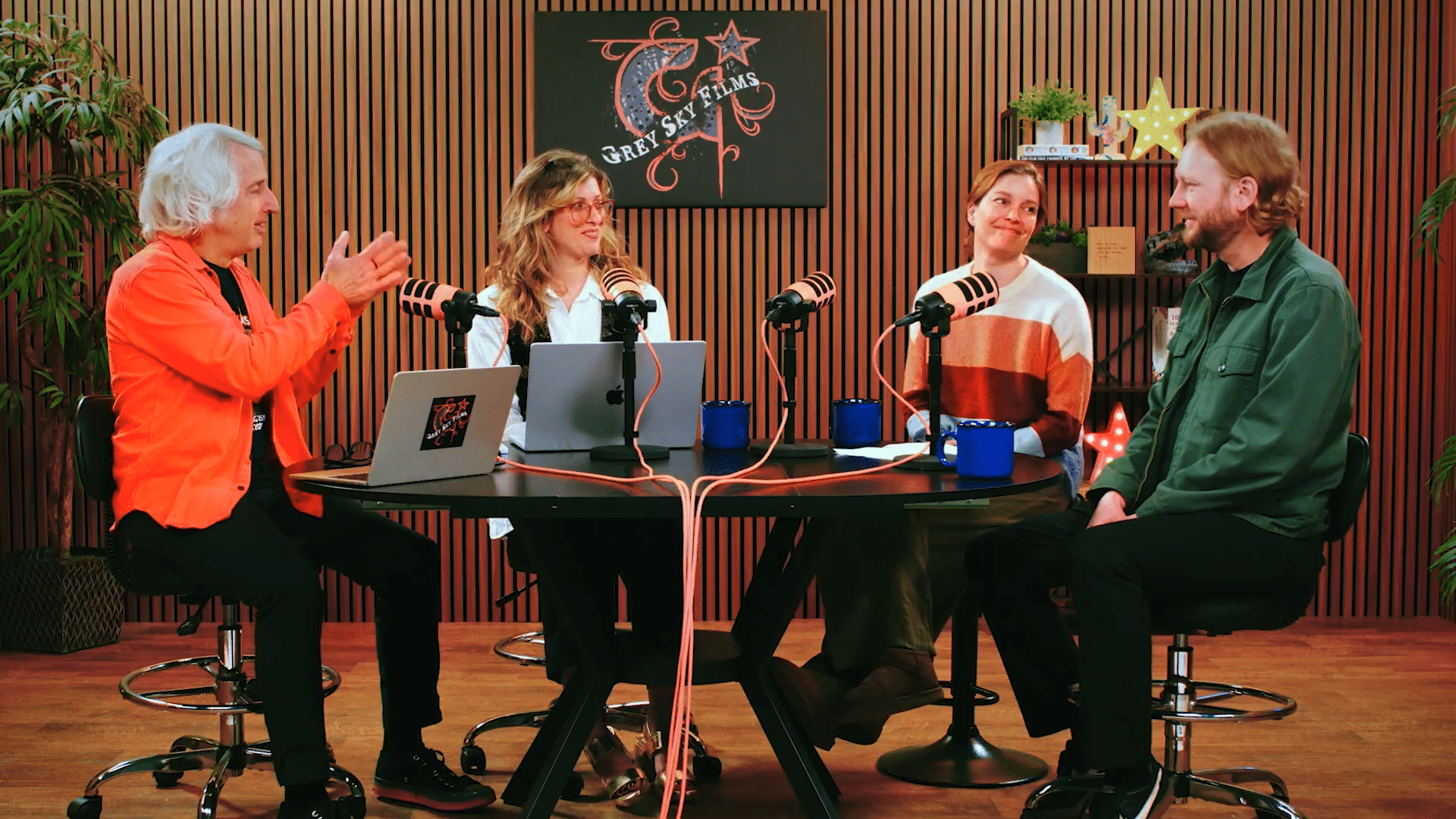
Host with Hanna and Brennan
Grey Sky Films Podcast Episode 1 explores why the best production days start long before the cameras roll.
Why Pre-Production Is Where the Shoot Is Won
Pre-Production Turns Creative Ideas Into a Real Shoot
Every great video starts with an idea, but an idea is not a production plan.
A concept might sound simple in a meeting: film a few interviews, capture some b-roll, show the facility, get leadership on camera, maybe include a few cinematic moments. But once you start asking real production questions, the complexity appears quickly.
- Where are we filming?
- Who needs to be there?
- How much time do we have with each person?
- Is the room quiet?
- Can we control the light?
- Where does the crew load in?
- Is there a freight elevator?
- Do we need a certificate of insurance?
- Can the client review the monitor?
- Who has final approval?
- What happens if the CEO only has 15 minutes?
This is why pre-production matters. It turns creative ambition into something executable.
Hanna describes the production manager’s role as organizing and overseeing the logistical and operational side of the shoot so the creative team can actually capture what was planned, while staying on budget, staying on schedule, and making sure the practical realities are handled.
That is the unglamorous but essential truth of professional video production: the final image depends on dozens of decisions that happen before the camera is ever turned on.
Key Takeaways
Pre-production is not just a planning phase. It is the foundation of the entire video production process.
A strong pre-production process helps:
- Build a realistic production schedule.
- Keep the shoot on budget.
- Avoid unnecessary overtime.
- Protect creative quality.
- Identify location, sound, lighting, safety, and access issues early.
- Help clients, agencies, crew, and talent stay aligned.
- Create more flexibility on set, not less.
- Make production day smoother, calmer, and more collaborative.
One of the strongest points Brennan makes in the episode is that planning does not limit creativity. It does the opposite. A better plan gives the team more freedom because everyone knows what is supposed to happen, what can change, and how to pivot when the unexpected shows up.
That is the difference between a production team reacting all day and a production team leading the day.

Pre-Production
Pre-production turns creative direction into a practical plan for the shoot day.
A Strong Schedule Creates More Creative Freedom
One of the biggest misconceptions about video pre-production is that a detailed schedule makes a shoot rigid.
In reality, the opposite is usually true.
As Brennan explains in the episode, a strong schedule gives the team a clear understanding of where the day is going. If something changes, everyone can adapt from a shared plan instead of trying to invent the plan in real time.
That matters because production days always change.
Weather changes.
Talent runs late.
A room is louder than expected.
A client gets pulled into a meeting.
A shot takes longer than planned.
A location needs to be reset.
A crew move takes 30 minutes longer than anyone hoped.
Without a strong schedule, every change becomes chaos. With a strong schedule, the team can make informed decisions.
Maybe two shots can be combined.
Maybe an interview moves earlier.
Maybe a company move gets shifted.
Maybe a lower-priority shot is dropped to protect the hero moment.
That kind of decision-making only works when there is a plan to react against.
For brands, agencies, and marketing teams reviewing video production services, this is one of the most important things to understand: a production schedule is not just an internal crew document. It is a creative protection tool.
It protects the client’s investment.
It protects the final video.
It protects the crew’s ability to work at a high level.
And it protects the production from losing time in ways that could have been avoided.

Brennan Discussing Scheduling
A strong production schedule helps the crew move efficiently and adapt when conditions change.
Location Scouts and Tech Scouts Reveal the Problems You Do Not Want to Find on Shoot Day
A location can look great in photos and still be a nightmare to film in.
That is why location scouting and tech scouting are such important parts of the pre-production process.
In the episode, the team talks through the difference between choosing a location creatively and evaluating whether that location actually works technically. A director may love the look of a room. But the production team also has to ask:
- Can we get gear into the building?
- Is there enough power?
- Can we control the light?
- Where does hair and makeup go?
- Where does the client sit?
- Where does crafty go?
- Can the crew stage equipment without disrupting the business?
- Is there HVAC noise?
- Are there planes, trains, construction, or leaf blowers nearby?
- Can we legally and safely film there?
This is especially important in corporate video production, healthcare environments, industrial spaces, schools, manufacturing facilities, military bases, and active office buildings. Grey Sky Films works across a wide range of industries, and every environment brings its own production challenges.
A hospital may have patient flow and privacy concerns.
A corporate office may have elevators, security, and active employees.
A manufacturing facility may have safety rules and sound issues.
An outdoor location may have weather, sun, heat, traffic, and continuity challenges.
These are not small details. They are the kinds of details that can derail a shoot.
The episode includes a great example of filming on a military base, where security could take anywhere from 30 minutes to three hours. Because the team asked ahead of time, they built in extra time. It still took nearly two hours, but it did not destroy the day because the schedule accounted for it.
That is pre-production doing its job.

Location Scouting
Scouting helps identify access, sound, lighting, safety, and logistical issues before production day.
Pre-Production Helps Clients Make Decisions Before Those Decisions Cost Time
A video shoot is full of decisions.
- What should the talent wear?
- Which version of the product should be shown?
- Is the lighting bright and polished or dark and dramatic?
- Which props are approved?
- Who signs off on the set design?
- Does the CEO want the hat on or off?
Some decisions sound small until they affect continuity.
In the episode, the team talks about the dreaded phrase: “Can we shoot it both ways?”
Sometimes, yes. If it is planned for.
But if a client asks to shoot the first scene both ways — with a wardrobe change, prop change, or performance variation — that choice can multiply across the entire day. Suddenly, every related shot may need to be captured both ways. What sounded like a simple option becomes a major schedule issue.
That does not mean the answer is always no. It means the decision needs to happen early enough for the production team to plan for it.
This is where client communication becomes part of the creative process.
Mood boards, storyboards, shot lists, wardrobe references, production design references, pre-production calls, and approval documents all help reduce uncertainty. They give clients a chance to react before the crew, talent, location, and equipment are all on the clock.
This is especially valuable for agency and brand work, where multiple stakeholders may be involved. If the person with final approval arrives on set without seeing the plan, the production can suddenly change direction at the worst possible moment.
Good pre-production brings those voices into the process early.
You can see this same principle across the best case studies: successful video work is not just about what was captured. It is about how clearly the goals, audience, message, logistics, and creative direction were defined before production began.
Safety, Contingencies, and Crew Experience Are Part of the Final Product
Pre-production is not only about efficiency. It is also about safety.
The episode covers several real-world examples: working with live needles for pharmaceutical training videos, planning driving shots, filming in extreme heat, dealing with outdoor environments, and even the story of a proposed scene involving a real bear.
The lesson is not that every shoot has extreme conditions. The lesson is that production teams have to ask the right questions before something becomes a safety issue.
If there are weapons, animals, vehicles, medical props, drones, extreme temperatures, water, heights, heavy gear, active facilities, or public spaces involved, the safety conversation belongs in pre-production.
The same applies to crew comfort and performance.
On one shoot discussed in the episode, the team filmed at a racetrack in Palm Springs in extreme heat. That required shade, transportation, coolers, safety conversations, and planning around how long people should be exposed to the conditions.
That kind of preparation is not extra. It is part of doing the job properly.
Because when people are exhausted, overheated, rushed, confused, or unsafe, the final product suffers.
A good production company understands that the experience on set affects what ends up on screen. That is part of the reason Grey Sky Films emphasizes thoughtful planning across its work and client relationships.

Crew Safety
Contingency planning protects the crew, the client experience, and the quality of the final video.
Rehearsals and Pre-Interviews Save Time When It Matters Most
One of the most useful parts of the episode comes near the end, when the conversation turns to rehearsals.
In corporate video production, not everyone on camera is a trained actor. They may be doctors, executives, employees, engineers, founders, nonprofit leaders, or customers. They know their world, but they may not be comfortable under lights, on camera, or reading from a teleprompter.
That is why pre-interviews, script reads, and rehearsal time can make such a difference.
Reading a script silently is not the same as saying it out loud. Words that look fine on paper may feel awkward when spoken. Sentences may be too long. Ideas may repeat. A phrase may not sound like something the person would naturally say.
Practicing before the shoot gives the team time to adjust.
It also helps the person on camera feel less like they are doing it for the first time when the room is full of crew, lights, monitors, and expectations.
For marketing teams planning a corporate, brand, recruiting, training, testimonial, or interview-based video, this is a major takeaway: preparation is not just for the crew. It is for the people appearing on camera too.
The more prepared they are, the better the performance.
The better the performance, the better the edit.
The better the edit, the stronger the final video.
Summary: Fix It in Pre
The old production joke is “fix it in post.”
But the smarter approach is to fix it in pre.
Pre-production is where the production team protects the shoot from unnecessary problems. It is where the creative vision becomes a practical plan. It is where logistics, scheduling, safety, approvals, locations, sound, lighting, talent, clients, and crew all come into alignment.
And most importantly, it is where the team creates enough structure to allow for real creativity on set.
Because the goal of pre-production is not to remove spontaneity. The goal is to make room for it.
When everyone knows the plan, the team can pivot.
When the risks are identified, the team can solve them.
When the client is aligned, the shoot moves faster.
When the schedule is realistic, the creative work gets better.
When the crew is supported, the final product improves.
That is why pre-production matters.
Whether you are planning a brand film, corporate video, commercial, training series, recruitment campaign, testimonial, or social content package, the work you do before production day will shape everything that happens after it.
To learn more about how Grey Sky Films approaches strategy, planning, production, and post-production, explore our services, learn more about Grey Sky Films, or request a quote for your next video project.
FAQ: Video Pre-Production and Planning
What is pre-production in video production?
Pre-production is the planning phase that happens before filming begins. It includes creative development, scheduling, budgeting, location scouting, shot lists, scripts, storyboards, crew planning, client approvals, safety planning, and logistics. In short, it is the work that makes the shoot possible.
Why does pre-production matter?
Pre-production matters because it helps prevent avoidable problems on shoot day. A strong pre-production process keeps the project organized, protects the schedule, controls costs, improves communication, and gives the creative team more freedom to focus on the final video.
Does pre-production limit creativity?
No. Good pre-production usually creates more creative freedom, not less. When the team has a plan, they can move faster, adapt more easily, and spend more time improving the work instead of solving preventable logistical problems.
What happens during a location scout or tech scout?
A location scout evaluates whether a space works creatively. A tech scout goes deeper into execution: power, lighting, sound, access, load-in, staging areas, safety, client space, crew flow, and other practical production needs.
Why is scheduling so important for a successful video shoot?
A production schedule determines the order of the day and helps the crew understand what needs to happen, when it needs to happen, and what can move if something changes. A strong schedule helps prevent delays, overtime, rushed decisions, and missed shots.
How can clients help during pre-production?
Clients can help by approving creative direction early, confirming who has final decision-making authority, sharing location details, identifying restrictions, reviewing scripts, preparing on-camera participants, and communicating schedule limitations ahead of time.
When should I contact a video production company?
The earlier, the better. Bringing a production company in during the planning phase allows the team to help shape the concept, identify risks, build a realistic scope, and recommend the best approach for the budget and goals.